Print a diagram
You can print a database diagram and use the page markup grid to adjust the layout before printing. You can also configure diagram-specific print options, such as scale, page layout, notation style, and margins, in Print Setup.
Print a diagram
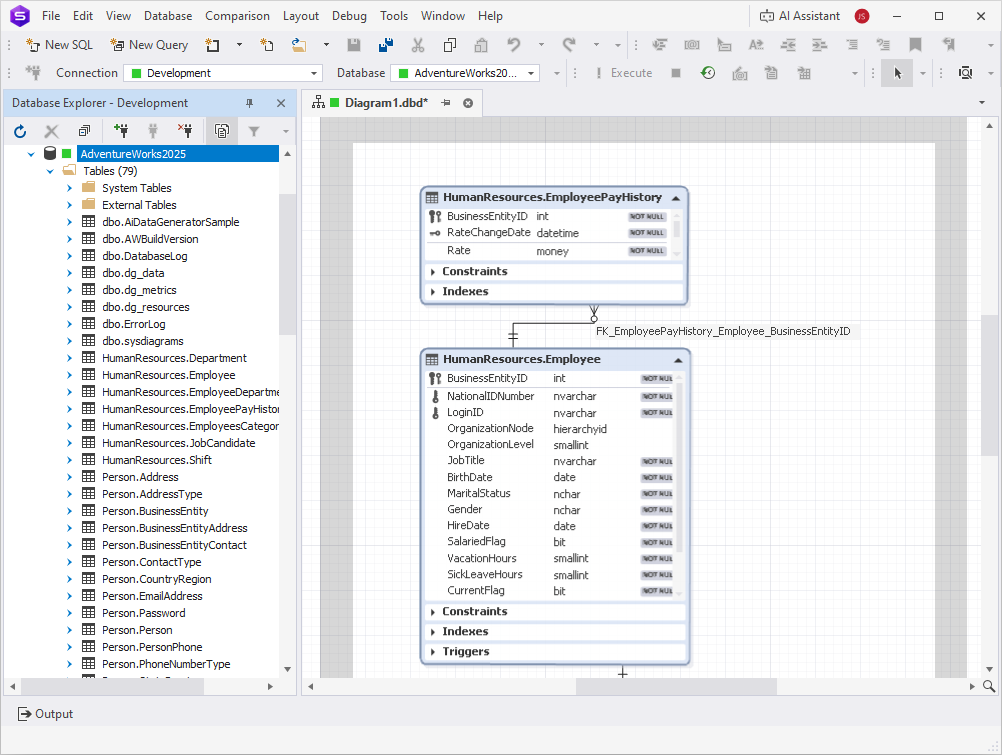
1. On the Database Diagram toolbar, click  to display the markup grid.
2. Arrange the diagram within the page markup grid. Gray stripes indicate page overlaps.
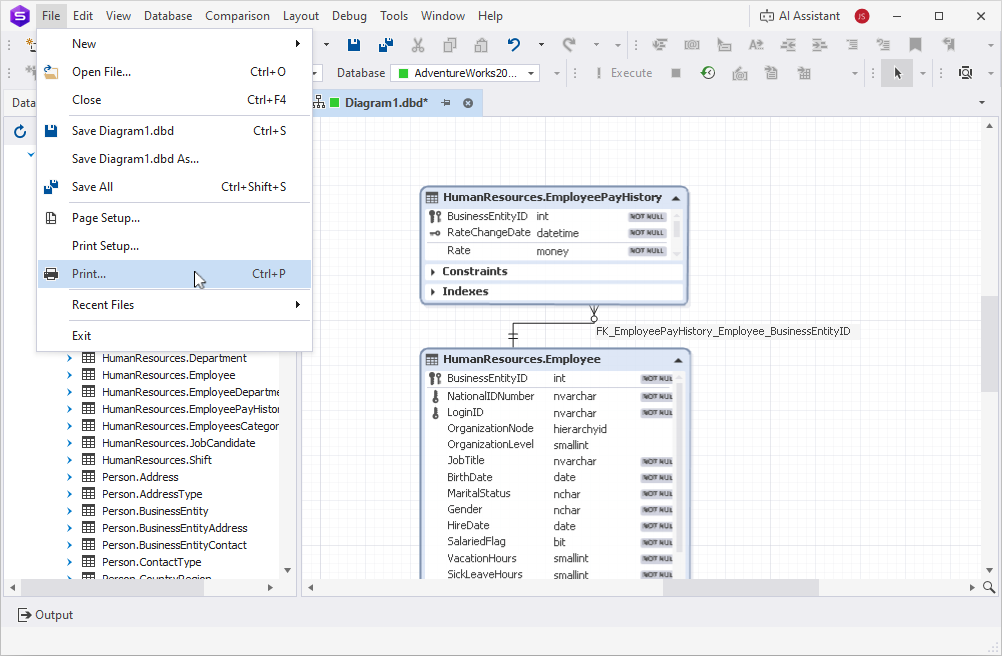
3. On the menu bar, select File > Print, or press Ctrl+P.
4. Optional: Configure the printing settings.
5. Click Print.
Tip
To hide the markup grid after printing, on the Database Diagram toolbar, click
Configure print setup options
1. On the menu bar, select File > Print Setup.
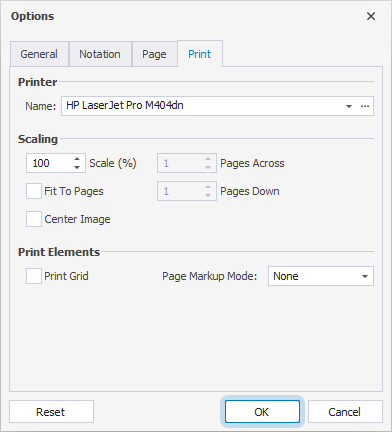
2. In the Options dialog, configure the print setup options.
3. Click OK.
Tip
- To restore all settings to their default values, click Reset.
- To close the dialog without saving changes, click Cancel.
Print setup options
The following tables describe print setup options you can configure in the Options dialog.
Print tab
| Option | Description |
|---|---|
| Printer | Specifies the printer used for printing. You can select an installed or virtual printer. |
| Scale (%) | Specifies the scale of the printed diagram. The default value is 100%. |
| Pages Across and Pages Down | Specifies the number of pages across and down used to print the diagram. |
| Fit to Pages | Scales the diagram to fit the specified number of pages across and down. |
| Center Image | Centers the diagram on the printed page. |
| Print Grid | Includes the diagram grid in the printed output. |
| Page Markup Mode | Adds markup lines to align and assemble printed pages. |
Page tab
| Option | Description |
|---|---|
| Size | Specifies the paper size. The default paper size is A4. |
| Source | Specifies the paper source tray. The option may be unavailable depending on the selected printer. |
| Orientation | Sets the page layout: Portrait (default) or Landscape. |
| Left, Right, Top, Bottom (margins) | Sets page margins in inches. The default value is 0.39. |
| Horizontal and Vertical (overlap) | Defines the overlap between pages when printing across multiple sheets. The default value is 5%. |
| Header Text | Specifies the text that appears at the top of each printed page. |
| Footer Text | Specifies the text that appears at the bottom of each printed page. |
Notation tab
| Option | Description |
|---|---|
| Relation Notation | Specifies the notation style for displaying relationships between tables. The possible values are:
|
| Show Relation Comments | Displays comments on relation lines in the diagram. |
| Table Compartment | Specifies which compartments are visible in table objects: Constraints, Indexes, and Triggers. |
| Field Details Level | Specifies the level of detail shown for each field in a table object. The possible values are:
|
| Separate Primary Keys | Displays primary key fields separately from other fields within table objects. |
General tab
| Option | Description |
|---|---|
| Auto Scale on Drop | Automatically resizes objects when you add them to the diagram. |
| Preserve Routing | Retains custom routing of relation lines when objects are moved. |
| Show Grid | Displays the grid on the diagram. |
| Enable Grid Snap | Automatically aligns objects to the grid when you move them. |
| Grid Step | Sets the grid spacing in pixels. The default value is 10. |
| Enable Shadows | Adds drop shadows to table objects on the diagram. |
| X Offset / Y Offset | Sets the horizontal and vertical offset of the shadow. The default value is 4. |