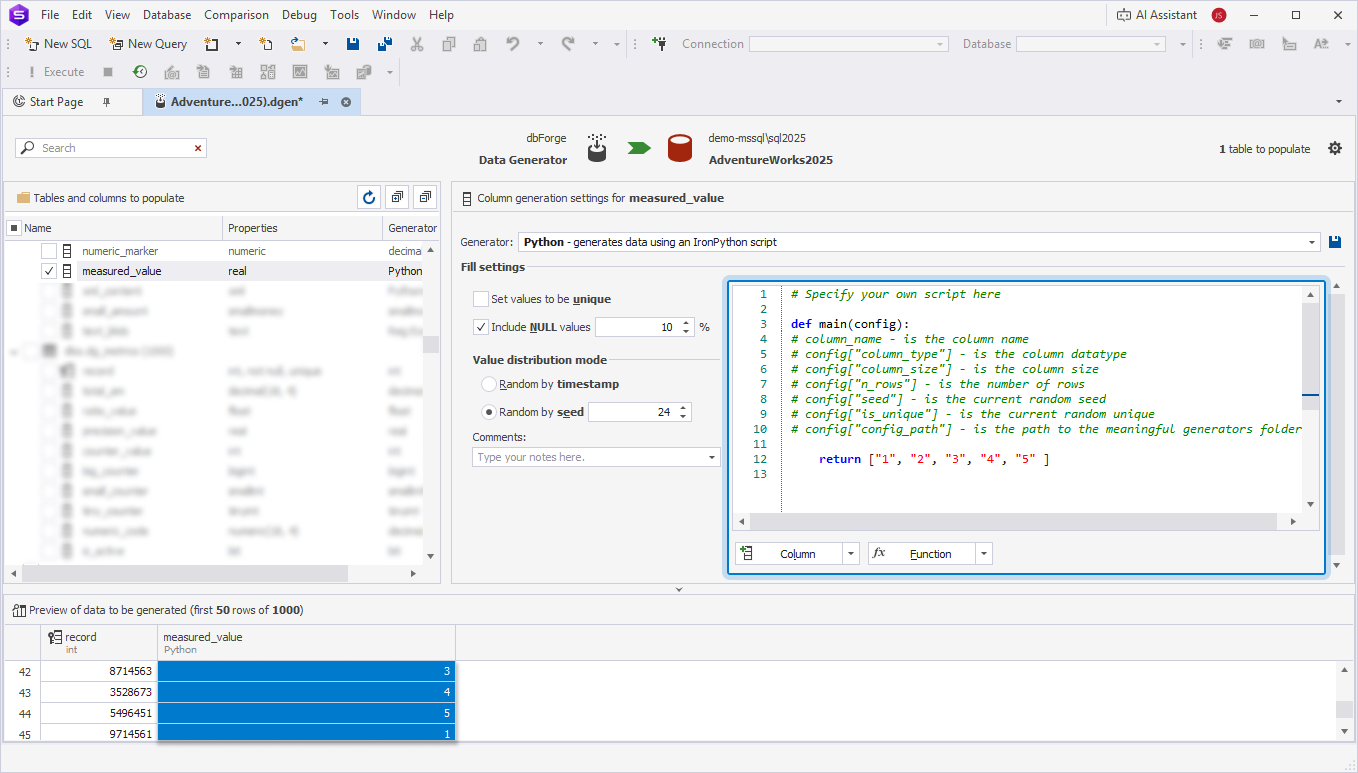
Python generator
The Python generator creates data using an IronPython script. Under Fill settings, you can set up basic and custom settings.
Custom settings
IronPython script text box: Specify your script in the text box.
You can use an IronPython script to generate data. The script must define a main() function that accepts a single config argument.
config is a dictionary that contains keys that you can use in your scripts.
You can specify values for the following keys:
config["column_type"]– The column data type.config["column_size"]– The column size.config["n_rows"]– The number of rows.config["seed"]– The current random seed.config["config_path"]– The path to the Meaningful Generators foldercolumn_name– The column name. Specifying the config argument beforecolumn_nameis optional. You can referencecolumn_namedirectly.
Use regular expressions
The Python generator supports the usage of the RegexGenerator inner class. Therefore, you can use regular expressions within the Python generator.
You can create the RegexGenerator in three ways:
mygen = RegexGenerator(regular expression)

mygen = RegexGenerator(regular expression, is unique data, data length)

mygen = RegexGenerator(regular expression, is unique data, data length, seed)
Where:
regular expression: Define an actual regular expression, for example,"[0-9A-Z]+”.is unique data: Define whether to generate unique data. Available parameters areFalseandTrue.data length: Specify the length of the longest value to generate. You can enter either a numeric value or an expression in the following format:config["column_size"].seed: Specify a seed value. You can enter either a numeric value or an expression in the following format:config["seed"].
Usage example
mygen = RegexGenerator("[0-9A-Z]+",False, 30)

def main():
i = 0
while i <= config["n_rows"]:
i = i + 1
varData = mygen.Generate();
yield varData

main()
Examples of Python scripts
Sequential read of rows from a text file:
# Read a txt file sequentially
def getColors():
    fileName = config["config_path"] +'\\'+  r"Colors.txt"
    with open(fileName) as f:
    content = f.readlines()
    for row in content:
    yield row

def main(config):
    return getColors()
Random read from a text file:
# Read a txt file randomly
import random

# Uncomment the line below to use a seed if needed
#random.seed(config["seed"])

def getColors():
    fileName = config["config_path"] +'\\'+  r"Colors.txt"
    with open(fileName) as f:
    content = f.readlines()
    for row in content:
        yield row

def main(config):
    colors = list(getColors())
    while True:
        yield colors[random.randint(0, len(colors)-1)]
Sequential read of data for a column from a CSV file:
# Read a csv file sequentially
import csv

def getCountryCodes():
    columnName = 'ISO3166-1-Alpha-2'
    fileName = config["config_path"] +'\\'+  r"CountryCodes.csv"
    with open(fileName,"rb") as file:
    reader = csv.DictReader(file, delimiter=';', quotechar='"')
    for row in reader:
        yield str(row[columnName]).upper()

def main(config):
    return getCountryCodes()
Random read of data for a column from a CSV file:
# Read a csv file sequentially
import csv
import random

# Uncomment the line below to use a seed if needed
#random.seed(config["seed"])

def getCountryCodes():
    columnName = 'ISO3166-1-Alpha-2'
    fileName = config["config_path"] +'\\'+  r"CountryCodes.csv"
    with open(fileName,"rb") as file:
    reader = csv.DictReader(file, delimiter=';', quotechar='"')
    for row in reader:
        yield str(row[columnName]).upper()

def main(config):
    codes = list(getCountryCodes())
    while True:
        yield codes[random.randint(0, len(codes)-1)]
Sequential read of rows from a XML file:
# Read an XML file
# Use the CLR XML libraries

import clr

clr.AddReference("System.Xml")
from System.Xml.XPath import XPathDocument, XPathNavigator

def getTitles(column_size=50):
    filename = r"D:\books.xml"
    doc = XPathDocument(filename)
    nav = doc.CreateNavigator()
    expr = nav.Compile("/catalog/book/title")
    titles = nav.Select(expr)
    for title in titles:
        yield str(title)[:column_size]

def main(config):
    # Truncate titles to the column size
    return list(getTitles(column_size=config["column_size"]))
Generation of male and female names from files depending on a flag:
# Select a name depending on a flag
import random

# Uncomment the line below to use a seed if needed
#random.seed(config["seed"])

def getPersonNames(fileName):
    fileName = config["config_path"] +'\\'+  fileName
    with open(fileName) as f:
    content = f.readlines()
    for row in content:
        yield row

def main(config):
    males = list(getPersonNames(r"FirstNamesMale.txt"))
    females= list(getPersonNames(r"FirstNamesFemale.txt" ))
    while True:
        # is_male - is a flag field
        if is_male:
        yield males[random.randint(0, len(males)-1)]
    else:
        yield females[random.randint(0, len(females)-1)]
Running a certain generator depending on a flag:
# Select a generator depending on a flag

def main(config):
    maleGen = RegexGenerator("Automotive|Computers|Crafts|Tools")
    femaleGen = RegexGenerator("Furniture|Pharmacy|Garden|Gifts")
    while True:
        # is_male - is a flag field
        if is_male:
        yield maleGen.Generate()
    else:
        yield femaleGen.Generate()
Calculating a new date based on a date value from other field:
# Calculate a date based on another date
import random

# Uncomment the line below to use a seed if needed
#random.seed(config["seed"])

def main(config):
# StartDate - is a column name
    if str(StartDate) == '':
        return DBNull.Value

# Add number of days to a StartDate
return StartDate.AddDays(random.randint(1, 1000));
Generator properties
The table provides key details about the generator, including its short name, examples of generated data, supported data types, and country-specific data.
| Short name | Example of generated data | Data type matching | Country-specific data |
|---|---|---|---|
| Python | EMP-1004, 3, 5 … | bigint, binary, bit, char, date, datetime, datetime2, datetimeoffset, decimal, float, hierarchyid, image, int, money, nchar, ntext, numeric, nvarchar(max), nvarchar, real, smalldatetime, smallint, smallmoney, sql_variant, text, time, tinyint, uniqueidentifier, varbinary(max), varbinary, varchar(max), varchar, xml | Default (United States) |
Matching rules
The generator can be assigned to a column that can have any name, regardless of the table name.
Preview of the column data generated by the Python generator