Option
|
Description
|
API Version
|
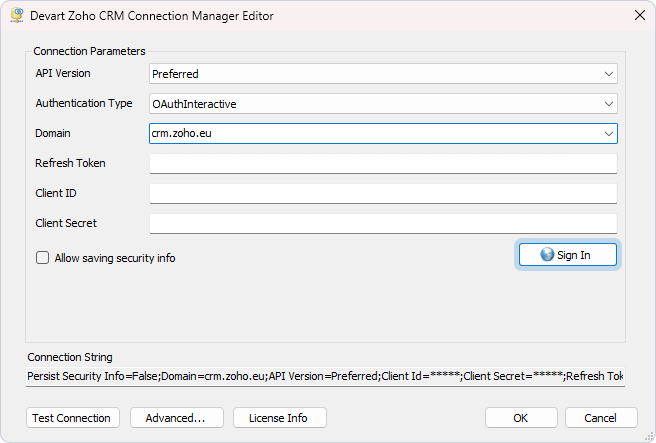
Specifies the version of Zoho CRM API to use. Note that API v1 has already reached End-of-Life.
|
Authentication Type
|
Specifies the authentication method used to connect to Zoho CRM, such as API Key or OAuth 2.0.
|
Client Id
|
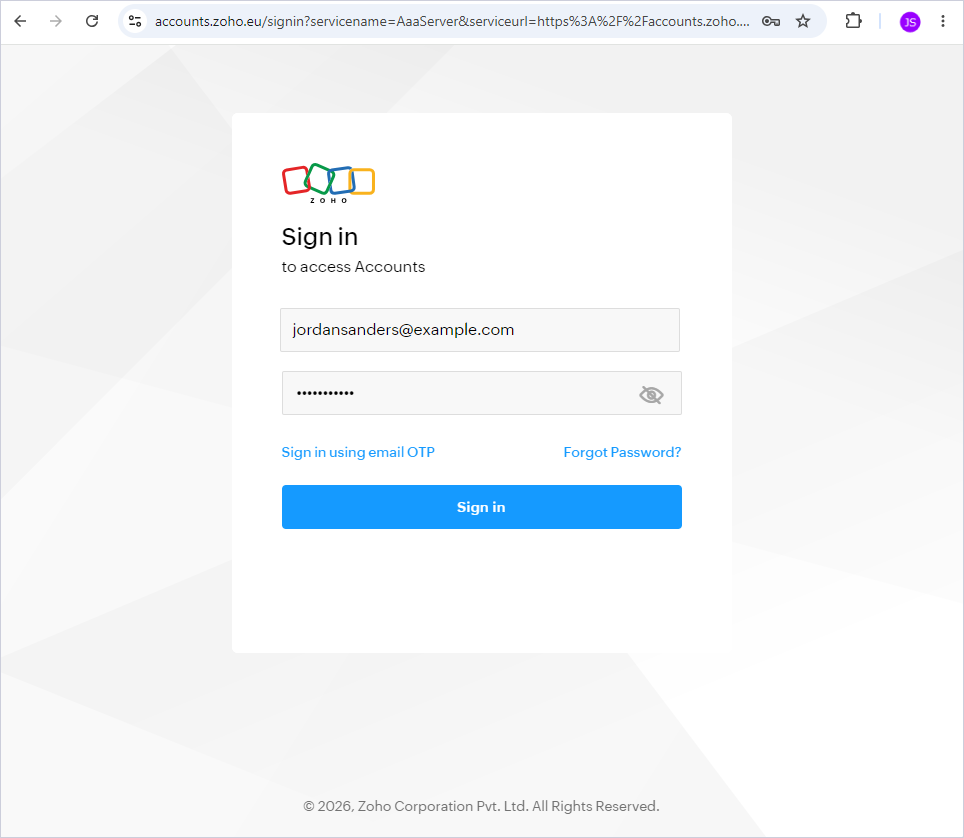
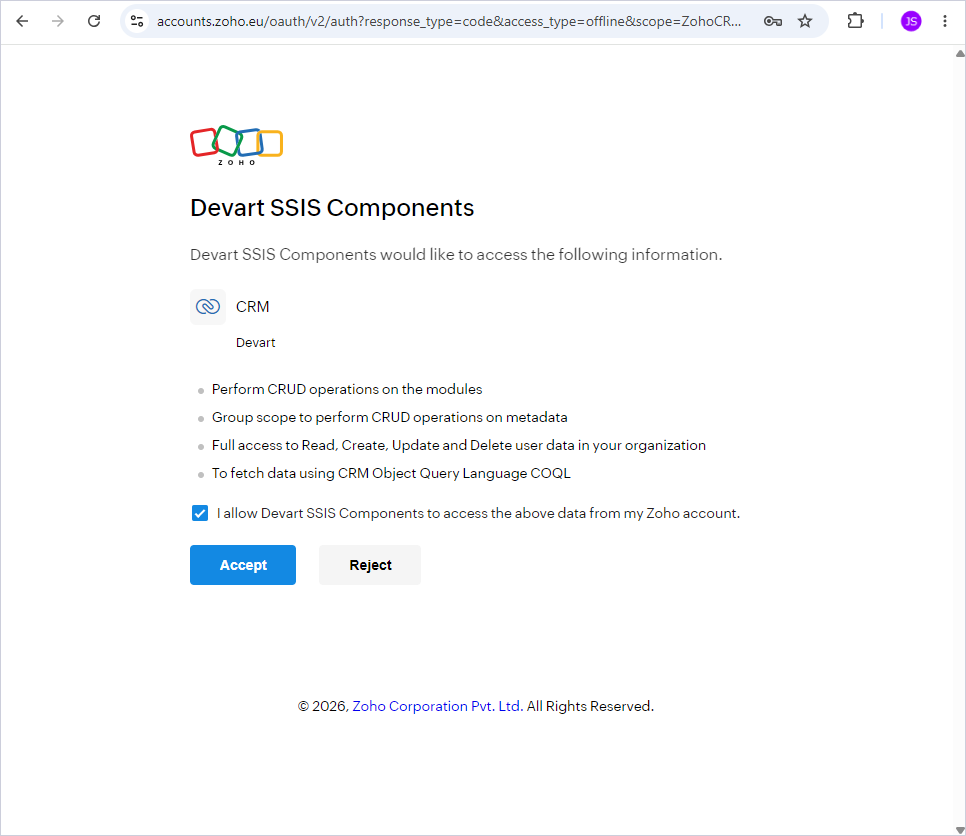
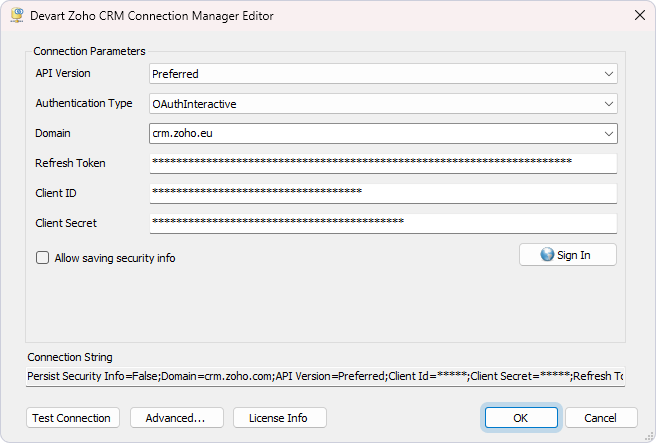
Specifies a unique identifier provided to every Zoho CRM client application when a Zoho CRM client application is registered with Zoho. This parameter is used for connecting via API v2, and is filled automatically when you perform Web Login.
|
Client Secret
|
Specifies a secret code, mapped to a Zoho CRM client application. This parameter is used for connecting via API v2, and is filled automatically when you perform Web Login.
|
Connection Lifetime
|
Specifies the maximum lifetime (in seconds) of a connection. When a connection is returned to the pool, its creation time is compared with the current time, and the connection is destroyed if that time span exceeds the value specified by Connection Lifetime. The default value is 0 (connection always returns to pool).
|
Connection Timeout
|
Specifies the length of time (in seconds) to wait for a connection to the server before terminating the attempt and generating an error. The default value is 60.
|
Default Command Timeout
|
Specifies the time in seconds to wait while trying to execute a command before terminating the attempt and generating an error.
|
Domain
|
Specifies the Zoho CRM domain base URL. Can be crm.zoho.com or crm.zoho.eu or crm.zoho.in or crm.zoho.com.cn or crm.zoho.com.au.
|
Enable Non Approved Records
|
Determines whether to include records that are pending approval in the results returned from Zoho CRM.
|
Failover Retries
|
Specifies the number of retries to perform a command if it fails because of the exception. The default value is 7.
|
Initialization Command
|
Specifies a data source-specific command to execute immediately after the connection is established.
|
Local SQL Engine
|
Determines whether to enable local SQL processing (enabled by default). Local SQL processing allows performing complex SELECT statements that cannot be directly compiled to Zoho CRM API calls. In this case ll the data from the mentioned cloud objects is queried to the local cache, and then the query is performed against the cache.
If local SQL processing is disabled, only simple SELECT statements that can be directly translated into Zoho CRM API calls can be used. More complex SELECT statements will fail.
|
Max Pool Size
|
Specifies the maximum number of connections allowed in the pool. Setting the Max Pool Size value in the connection string can affect performance. The default value is 100.
|
Min Pool Size
|
Specifies the minimum number of connections allowed in the pool. The default value is 0.
|
NormalizeDbNames
|
Determines whether database object names are normalized when retrieved from the database.
|
Persist Security Info
|
Indicates if security-sensitive information, such as the password, is not returned as part of the connection if the connection is open or has ever been in an open state.
|
Pooling
|
Specifies whether, by default, the connection is drawn from the appropriate pool or is created and added to the appropriate pool.
|
Proxy Host
|
Specifies the host name or IP address of the proxy server.
|
Proxy Password
|
Specifies the password for the proxy server account.
|
Proxy Port
|
Specifies the port number of the proxy server. The default value is 3128.
|
Proxy User
|
Specifies the proxy server account name.
|
Query API
|
Determines whether to use the Zoho CRM Query API (COQL) to execute SELECT queries, providing more advanced filtering capabilities than the standard API.
|
Readonly
|
Indicates whether the connection is read-only (allows only SELECT statements).
|
Refresh Token
|
Stores the Zoho CRM OAuth refresh token, used for connecting via API v2.
|
Run Once Command
|
Specifies a command to execute immediately after establishing the connection. Unlike Initialization Command, it is not executed for connections obtained from the connection pool.
|
SuppressExtendedRequests
|
Determines whether to suppress additional API requests required to retrieve extended data for Zoho CRM objects.
|
Token Server
|
Specifies the location, a file or a registry key, to store new refresh tokens between sessions. When set, SSIS Data Flow Components for Zoho CRM can query new refresh tokens automatically when the current one expires and store them between sessions. For example, "file://D:\temp\oauth_token_1234.txt" or "reg://HKEY_CURRENT_USER\Software\Devart\dotConnect\OAuth_12345"
|
Use Display Name For Custom Tables
|
Determines whether display names are used instead of module names to access custom Zoho CRM modules.
|
Use Display Name For Tables
|
Determines whether display names are used to access Zoho CRM modules instead of the module names.
|
UTC Dates
|
Converts dates to UTC format during import if set to True, and treats the date values entered by the user (in SELECT statements, etc.) as UTC dates when sending them to the data source.
|
 Connection Dialog