Advanced connection options
Devart ODBC Driver for ASE provides advanced connection options, allowing you to customize settings to suit your specific needs.
You can configure these custom settings when creating a new Windows DSN or modifying an existing DSN.
1. Open the ODBC Data Source Administrator.
2. Navigate to the User DSN or System DSN tab, depending on where the DSN for ASE is configured.
3. Select the ASE data source, then click Configure.
4. In the Devart ODBC Driver for Adaptive Server Enterprise Configuration dialog that opens, navigate to the Advanced Settings tab.
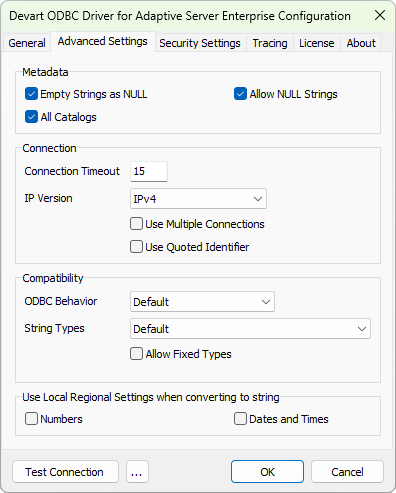
5. Configure the required settings, then click OK to save and apply the changes.
Available options
Metadata section
Empty Strings as NULL – Treats empty strings as NULL when reading and writing ASE data.
Allow NULL Strings – Allows string fields in the dataset to contain NULL values.
All Catalogs – Retrieves and displays all available catalogs (databases or schemas, depending on the database system) from the connected server.
Connection section
Connection Timeout – Sets the maximum time (in seconds) the driver will wait for a connection attempt before stopping. The default is 15 seconds.
IP Version – Specifies which Internet Protocol version the driver uses:
-
IPv4 – Uses Internet Protocol version 4 (IPv4).
-
IPv6 – Uses Internet Protocol version 6 (IPv6).
-
IPv4 + IPv6 – Uses either Internet Protocol version 6 (IPv6) or version 4 (IPv4). If IPv6 is enabled in the operating system, a connection is attempted via IPv6. If the connection attempt fails, a new connection attempt is made via IPv4.
Use Multiple Connections – Enables or disables creating additional connections to support concurrent sessions, commands, and rowset objects.
Use Quoted Identifier – Controls how Adaptive Server Enterprise interprets double-quoted text. When enabled, text in double quotes is treated as an identifier, which helps avoid conflicts with reserved words in procedures and queries. When disabled (default), text in double quotes is treated as a string literal.
Compatibility section
ODBC Behavior – Defines the ODBC behavior:
-
Default – Uses the default behavior of the driver.
-
Ver 2.x – Emulates ODBC 2.x behavior for compatibility with older applications.
-
Ver 3.x – Emulates ODBC 3.x behavior for compatibility with newer standards.
String Types – Select the string type for data exchange:
-
Default – Uses the driver’s default string type.
-
Ansi – Returns all string types as
SQL_CHAR,SQL_VARCHAR, andSQL_LONGVARCHAR. -
Unicode – Returns all string types as
SQL_WVARCHARandSQL_WLONGVARCHAR. -
Allow Fixed Types – Controls how data types are reported in metadata for Adaptive Server Enterprise. Since ASE cannot distinguish between fixed and variable types when preparing SQL statements, the driver returns variable types by default (
SQL_VARCHARinstead ofSQL_CHAR,SQL_WVARCHARinstead ofSQL_WCHAR, andSQL_VARBINARYinstead ofSQL_BINARY) to avoid compatibility issues with third-party tools.
Tip
Set the Allow Fixed Types option to True to return fixed data types (
SQL_CHAR,SQL_WCHAR,SQL_BINARY) in metadata instead.
Use Local Regional Settings when converting to string section
Numbers – Formats numbers according to the system’s local regional settings.
Dates and Times – Formats dates and times according to the system’s local regional settings.