Option
|
Description
|
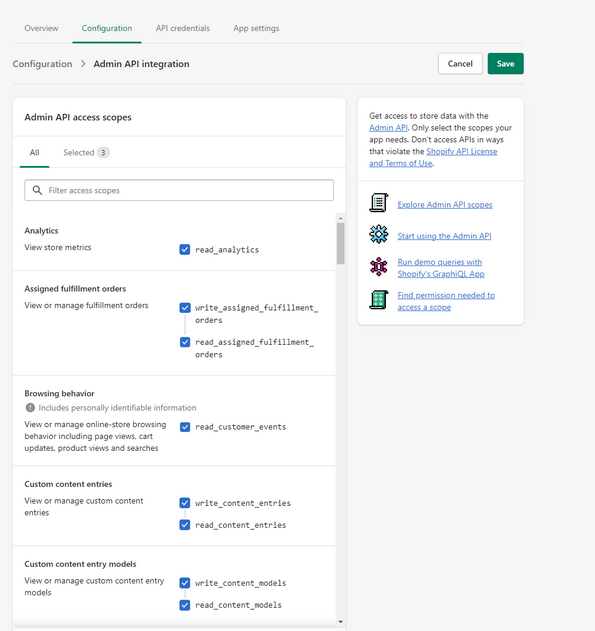
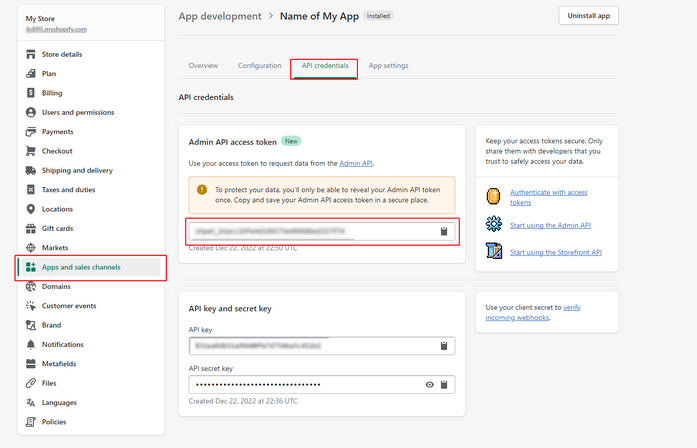
Access Token
|
Specifies an API access token that can be used to access the shop data. Used for the AccessToken authentication only.
|
API Key
|
Specifies the API Key used to identify the client application. Used for the APIKey authentication only.
|
Authentication Type
|
Determines whether to use AccessToken or APIKey authentication
|
Client Id
|
Specifies the client ID of your custom Shopify app. The value is used for the RefreshToken authentication type.
|
Client Secret
|
Specifies the client secret of your custom Shopify app. The value is used for the RefreshToken authentication type.
|
Connection Lifetime
|
Specifies the time span (in seconds), compared against a connection's creation time when it is returned to the pool; the connection is destroyed if this span is exceeded. The default value is 0 (connection always returns to pool).
|
Connection Timeout
|
Specifies the length of time (in seconds) to wait for a connection to the server before terminating the attempt and generating an error. The default value is 60.
|
Default Command Timeout
|
Specifies the time in seconds to wait while trying to execute a command before terminating the attempt and generating an error.
|
Failover Retries
|
Specifies the number of retry attempts to automatically re-run a command before displaying an error message in case when the command failed because of an error that may be temporary.
|
Initialization Command
|
Specifies a database-specific command to execute after establishing the connection.
|
Local SQL Engine
|
Determines whether to use local SQL engine for SELECT queries, that are too complex to translate them directly to Shopify API calls or to show an error message.
|
Max Pool Size
|
Specifies the maximum number of connections allowed in the pool. Setting the Max Pool Size value in the connection string can affect performance. The default value is 100.
|
Min Pool Size
|
Specifies the minimum number of connections allowed in the pool. The default value is 0.
|
NormalizeDbNames
|
Determines whether database object names are normalized when retrieved from the database.
|
Password
|
Specifies a password (or client secret) generated for the client application. Used for the APIKey authentication only.
|
Persist Security Info
|
Indicates if security-sensitive information, such as the password, is not returned as part of the connection if the connection is open or has ever been in an open state.
|
Pooling
|
Draws the connection from the appropriate pool, or creates and adds it to the appropriate pool, when set to true. This is the default behavior.
|
Proxy Host
|
Specifies the host name or IP address of the proxy server.
|
Proxy Password
|
Specifies the password for the proxy server account.
|
Proxy Port
|
Specifies the port number of the proxy server. The default value is 3128.
|
Proxy User
|
Specifies the proxy server account name.
|
Readonly
|
Indicates whether the connection is read-only (allows only SELECT statements).
|
Run Once Command
|
Specifies a database-specific command to execute after establishing the connection. Unlike Initialization Command, it is not executed for connections obtained from the connection pool.
|
Store
|
Specifies your Shopify store.
|
Token Server
|
Is not used for Shopify.
|
UTC Dates
|
Converts dates to UTC format during import when set to True; the date values entered by the user (in SELECT statements, etc.) are then considered UTC dates when sending them to the data source.
|
 Connection Dialog