Entity Framework Tutorial
On this page
This tutorial guides you through the process of creating a simple application
powered by ADO.NET Entity Framework. In less than 5 minutes you will have a
ready-to-use data access layer for your business objects.
Please note that this tutorial is not applicable for Entity Framework Core. It is intended for previous Entity Framework versions.
In this walkthrough:
Introducing the ADO.NET Entity Framework
ADO.NET Entity Framework is an object-relational mapping (ORM) framework for
the .NET Framework. It is designed to enable developers to create data access
applications by programming against a conceptual application model instead of
programming directly against a relational storage schema. The goal is to
decrease the amount of code and maintenance required for data-oriented
applications.
Requirements
In order to connect to BigCommerce server you need the corresponding BigCommerce connection parameters,
dotConnect for BigCommerce installed and IDE running.
For Entity Framework 6, you will also need a NuGet Visual Studio extension installed since it is used for adding EntityFramework NuGet package. Alternatively you may create model for Entity Framework v4, which don't require NuGet, in this tutorial.
In this sample we will create a simple console application. It could be any other
project type as well, but for simplicity's sake we'll use console project
throughout the tutorial. Start Visual Studio and create a new console application.
Entity Framework v6
The following actions are required if you want to create an Entity Framework v6 model.
Open the Package Manager Console window and execute the following command in it.
|
|---|
install-package EntityFramework |
After this add the following line:
|
|---|
<provider invariantName="Devart.Data.Bigcommerce" type="Devart.Data.Bigcommerce.Entity.BigcommerceEntityProviderServices,
Devart.Data.Bigcommerce.Entity.EF6, Version=1.0.0.0, Culture=neutral, PublicKeyToken=09af7300eec23701" />
|
to the entityFramework -> providers section.
|
|---|
<entityFramework>
    <providers>
      <provider invariantName="Devart.Data.Bigcommerce" type="Devart.Data.Bigcommerce.Entity.BigcommerceEntityProviderServices,
      Devart.Data.Bigcommerce.Entity.EF6, Version=1.0.0.0, Culture=neutral, PublicKeyToken=09af7300eec23701" />
    </providers>
</entityFramework>
|
Note: replace 1.0.0.0 with the actual assembly version.
After this you need to rebuild the project before running the EDM wizard.
Generating Model from Database
- In Solution Explorer, right-click the project and select Add > New Item.
- Select ADO.NET Entity Data Model, click Add. Entity Data Model Wizard opens.
- Select EF Designer from database, click Next.
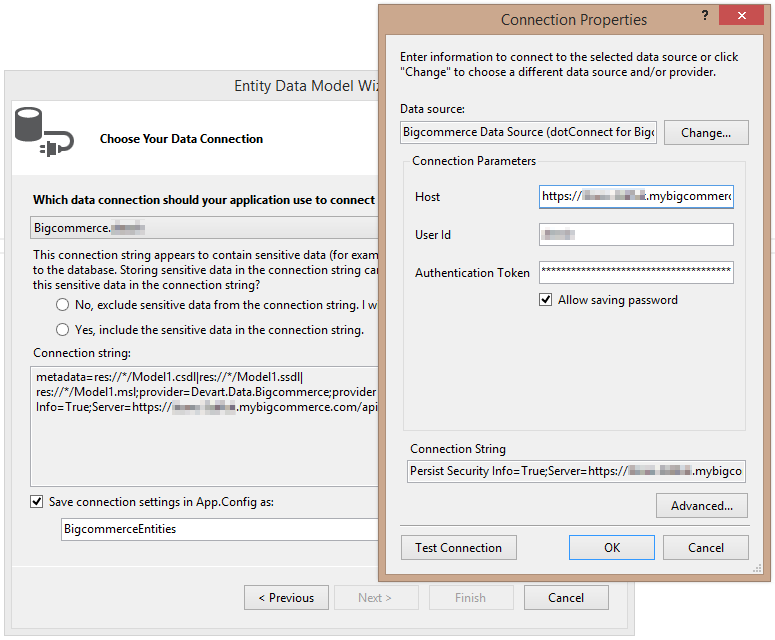
- Select an existing dotConnect for BigCommerce connection or create a new one. When creating a new connection, under Data Source, select BigCommerce Data Source, and under Data provider, select dotConnect for BigCommerce.
- Agree to include the sensitive data in the connection string.
- Under Save connection settings in App.Config as, enter BigcommerceEntities. This will be the name of the main data access class. Click Next.
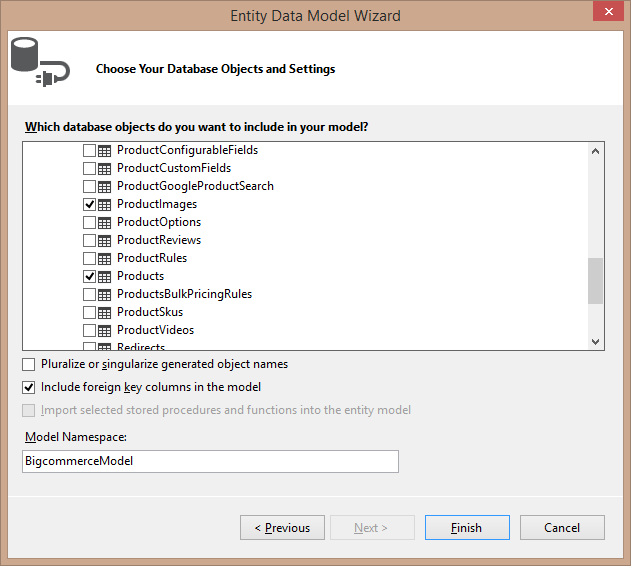
- Select database objects that will be used in the model. Enter BigcommerceModel in the Model Namespace box.
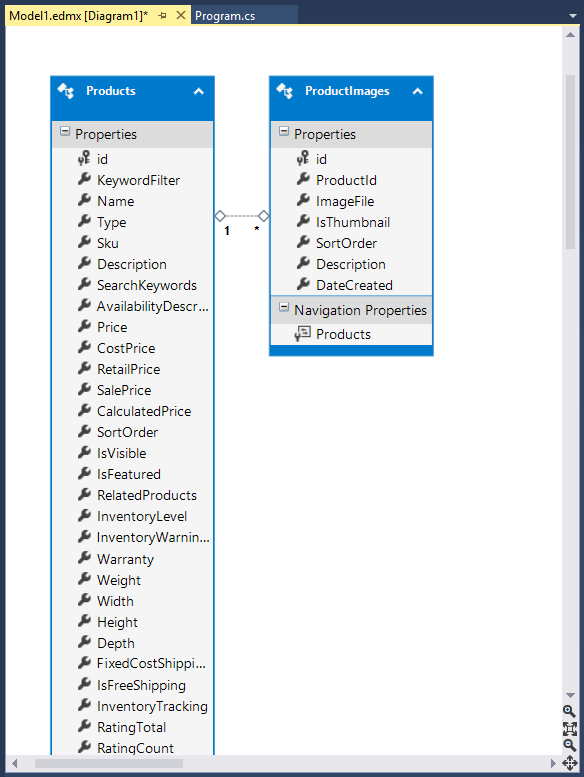
- Click Finish. The model will be generated and opened in EDM Designer.
The model you've just generated is ready to use. Its name is Model1.edmx,
unless you changed it in the step 2. You can inspect it visually in the
designer or take a look behind the scenes with XML Editor.
The wizard creates classes for all selected tables that represent entities.
It also creates a descendant of System.Data.Objects.DbContext class,
which controls the connection to the database, and the whole data flow. This
class includes properties and methods named after your database objects.
You will use these members to retrieve and modify data in the context.
The code is contained in an autogenerated file Model1.Designer.cs (Model1.Designer.vb).
Note that if you have an association between two properties of non-coinciding numeric
types, you can manually change both conceptual and storage types to the type
that will be wide enough to include data for each property.
Querying Data
All Entity Framework operations are executed through a DbContext descendant (default since Visual Studio 2012)
or through a ObjectContext descendant. In our tutorial, it's a DbContext descendant, which is named BigcommerceEntities. To retrieve
data you have to first create an instance of the context, then prepare a
query with LINQ to Entities or EntitySQL or their mix, and
then access the object returned by the query, which may be a collection of
objects or a single object.
Let's try performing a LINQ to Entities query against our model.
Add the following block of code to the method Main:
|
|---|
BigcommerceEntities context = new BigcommerceEntities();
var query = from it in context.Products
            orderby it.Name
            select it;

foreach (Products p in query)
    Console.WriteLine("{0} | {1} | {2}", p.Name, p.Price, p.Weight);

Console.ReadLine();
|
|
|---|
Dim context As New BigcommerceEntities
Dim query = From it In context.Products
    Order By it.Name
    Select it

Dim p As Products
For Each p In query
    Console.WriteLine("{0} | {1} | {2}", p.Name, p.Price, p.Weight)
Next

Console.ReadLine()
|
As simple as that. You prepare a query and then iterate through it as you would
do with a usual collection of objects. The database interaction is performed by
Entity Framework in the background. Now let's see who is who in this code sample.
-
BigcommerceEntities is the name of the class that knows all about your
model and does everything to handle it. You named it in the step 6. All
Entity Framework operations are performed within this class's properties
and methods. It is recommended that you keep a single instance of the class
throughout your application because it consumes lots of resources.
-
query, it - these are arbitrary variable names in the LINQ to Entities
statement. The former is used as the collection of data objects, the
latter is not used outside the statement.
-
context.ENTITY refers to a public property of
BigcommerceEntities class. This property represents the collection of the corresponding objects in the context.
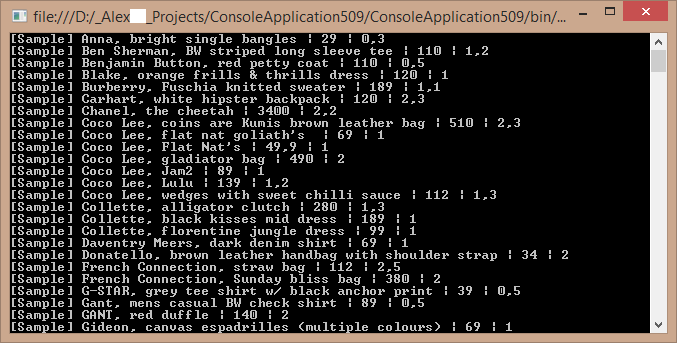
Here is the project's output in the console:
Note that the LINQ to Entities query code just describes the query. It does not execute it.
This approach is known as deferred execution.
Now let's query data from two objects united with a relation. Replace the old
code with this:
|
|---|
// Add references to the following assemblies in your project:
// Devart.Data.dll,  Devart.Data.SqlShim.dll, Devart.Data.Bigcommerce.dll, Devart.Data.Bigcommerce.Entity.EF6.dll
var monitor = new Devart.Data.Bigcommerce.BigcommerceMonitor() { IsActive = true };

 BigcommerceEntities context = new BigcommerceEntities();
 var query = from it in context.Products.Include("ProductImages")
             orderby it.Name
             select it;

 foreach (Products product in query)
     Console.WriteLine("{0} | {1} | {2}",
         product.Name, product.Price,
         product.ProductImages.FirstOrDefault() == null ? "null" : product.ProductImages.FirstOrDefault().ImageFile
         );

 Console.ReadLine();
|
|
|---|
' Add the references to the following assemblies in your project:
' Devart.Data.dll, Devart.Data.SqlShim.dll, Devart.Data.Bigcommerce.dll, Devart.Data.Bigcommerce.Entity.EF6.dll
Dim monitor As New Devart.Data.Bigcommerce.BigcommerceMonitor()
monitor.IsActive = True

 Dim context As New BigcommerceEntities
 Dim query = From it In context.Products.Include("ProductImages")
     Order By it.Name
     Select it

 For Each product As Products In query
     Console.WriteLine("{0} | {1} | {2}", product.Name, product.Price,
                         If(product.ProductImages.FirstOrDefault() Is Nothing, "null", product.ProductImages.FirstOrDefault().ImageFile))
 Next

 Console.ReadLine()
|
This sample is much like the previous one, with exception that it adds the
Include method that instructs the query to retrieve data from one
more object.
Inserting New Data
What earlier was adding rows to tables, now is just adding new objects to
context collections. When you are ready to send the changes to the database,
call the SaveChanges() method of the context. Before doing this, you must
first set all properties that do not support null (Nothing)
values. The SaveChanges() method generates and executes commands that perform
the equivalent INSERT, UPDATE, or DELETE statements against the data source.
By Microsoft design, DbContext.SaveChanges() should work within a distributed transaction, but it is not supported by API of BigCommerce. That's why SaveChanges() will submit all DML operations (till the failed one, if any). This code snippet includes enabled BigcommerceMonitor for tracing the SQL statements sent to data source.
Let's add new objects to the data source. Replace the old
code with this:
|
|---|
// Add references to the following assemblies in your project:
// Devart.Data.dll,  Devart.Data.SqlShim.dll, Devart.Data.Bigcommerce.dll, Devart.Data.Bigcommerce.EF6.dll
var monitor = new Devart.Data.Bigcommerce.BigcommerceMonitor() { IsActive = true };

BigcommerceEntities context = new BigcommerceEntities();

// Create a new product image
var i = new ProductImages();
i.ImageFile = "https://www.devart.com/images/logo/devart-logo.png";
context.ProductImages.Add(i);

// Create a new product
var p = new Products();
p.Name = "new product";
p.Type = "physical";
p.Price = 99;
p.Weight = 2;
p.Categories = "[1]";
p.Availability = "available";
p.InventoryTracking = "none";
p.EventDateType = "none";
p.Condition = "New";
p.OpenGraphType = "product";
p.OptionSetDisplay = "right";

// Associate the product image with the new product
p.ProductImages.Add(i);
context.Products.Add(p);

// Send the changes to the database.
// Until you do it, the changes are cached on the client side.
context.SaveChanges();

// Request the new product from the database
var query = from it in context.Products.Include("ProductImages")
            where it.Name == "new product"
            select it;

// Since we query for a single object instead of a collection, we can use the method First()
Products product = query.First();
Console.WriteLine("{0} | {1} ",
    product.ProductImages.First().ImageFile, product.Name);
Console.ReadLine();
|
|
|---|
' Add the references to the following assemblies in your project:
' Devart.Data.dll, Devart.Data.SqlShim.dll, Devart.Data.Bigcommerce.dll, Devart.Data.Bigcommerce.EF6.dll
Dim monitor As New Devart.Data.Bigcommerce.BigcommerceMonitor()
monitor.IsActive = True

Dim context As New BigcommerceEntities

' Create a new product image
Dim i As New ProductImages
i.ImageFile = "https://www.devart.com/images/logo/devart-logo.png"
context.ProductImages.Add(i)

' Create a new product
Dim p = New Products()
p.Name = "new product"
p.Type = "physical"
p.Price = 99
p.Weight = 2
p.Categories = "[1]"
p.Availability = "available"
p.InventoryTracking = "none"
p.EventDateType = "none"
p.Condition = "New"
p.OpenGraphType = "product"
p.OptionSetDisplay = "right"

' Associate the product image with the new product
p.ProductImages.Add(i)
context.Products.Add(p)

' Send the changes to the database.
' Until you do it, the changes are cached on the client side.
context.SaveChanges()

' Request the new product from the database
Dim query = From it In context.Products.Include("ProductImages")
            Where it.Name = "new product"
            Select it

' Since we query for a single object instead of a collection, we can use the method First()
Dim product = query.First()
Console.WriteLine("{0} | {1} ",
    product.ProductImages.First().ImageFile, product.Name)
Console.ReadLine()
|
The Add methods and others
are automatically generated in the context. Such methods exist for every entity
in your model.
Updating Data
Entity instances are modified as usual. The only thing to remember is that you
have to invoke the SaveChanges() method to send the data to the database.
Append the following block to the existing code and launch the project:
|
|---|
product.Name = "edited name";
context.SaveChanges();
|
|
|---|
product.Name = "edited name"
context.SaveChanges()
|
Deleting Data
To extract an instance from a context use the DeleteObject method of the context.
The object is removed from the collection of its type, but not destroyed. To delete
the object's data from the database invoke the SaveChanges() method.
You can do this with a block of code like the following:
|
|---|
context.Products.Remove(product);
context.ProductImages.Remove(productImage);
context.SaveChanges();
|
|
|---|
context.Products.Remove(product)
context.ProductImages.Remove(productImage)
context.SaveChanges()
|
Additional Information
Now that you can perform the basic data manipulation with Entity Framework,
you can move on to some advanced topics.
We recommend you to use Entity Developer (Devart Entity Model, *.edml) instead of EDM Designer (ADO.NET Entity Data Model, *.edmx) because it is adjusted for working with BigCommerce and offers advanced functionality. Additionally, Entity Developer registers Entity Framework v6 providers in app.config automatically and offers advanced visual designer and support for Database First / Model First approaches for EF Core.
Here are some useful links to MSDN:
For hands-on experience download the separate
Entity Framework Query Samples
(EF1/EF4/EF5/EF6) package or use samples shipped with dotConnect for BigCommerce. You can access the samples
from the Start menu.
To understand deeper the works of Entity Framework engine you can watch the
generated SQL statements in dbMonitor.
See Also
Entity Framework section
| Entity Framework Support Overview